
The Determinism Problem
Why Agent Systems Need a Deterministic Execution Layer

Current generation agent systems usually reach production in a state that is difficult to describe honestly. They work often enough to justify the investment, fail rarely enough to resist simple diagnosis, and vary just enough between runs to make every incident expensive.
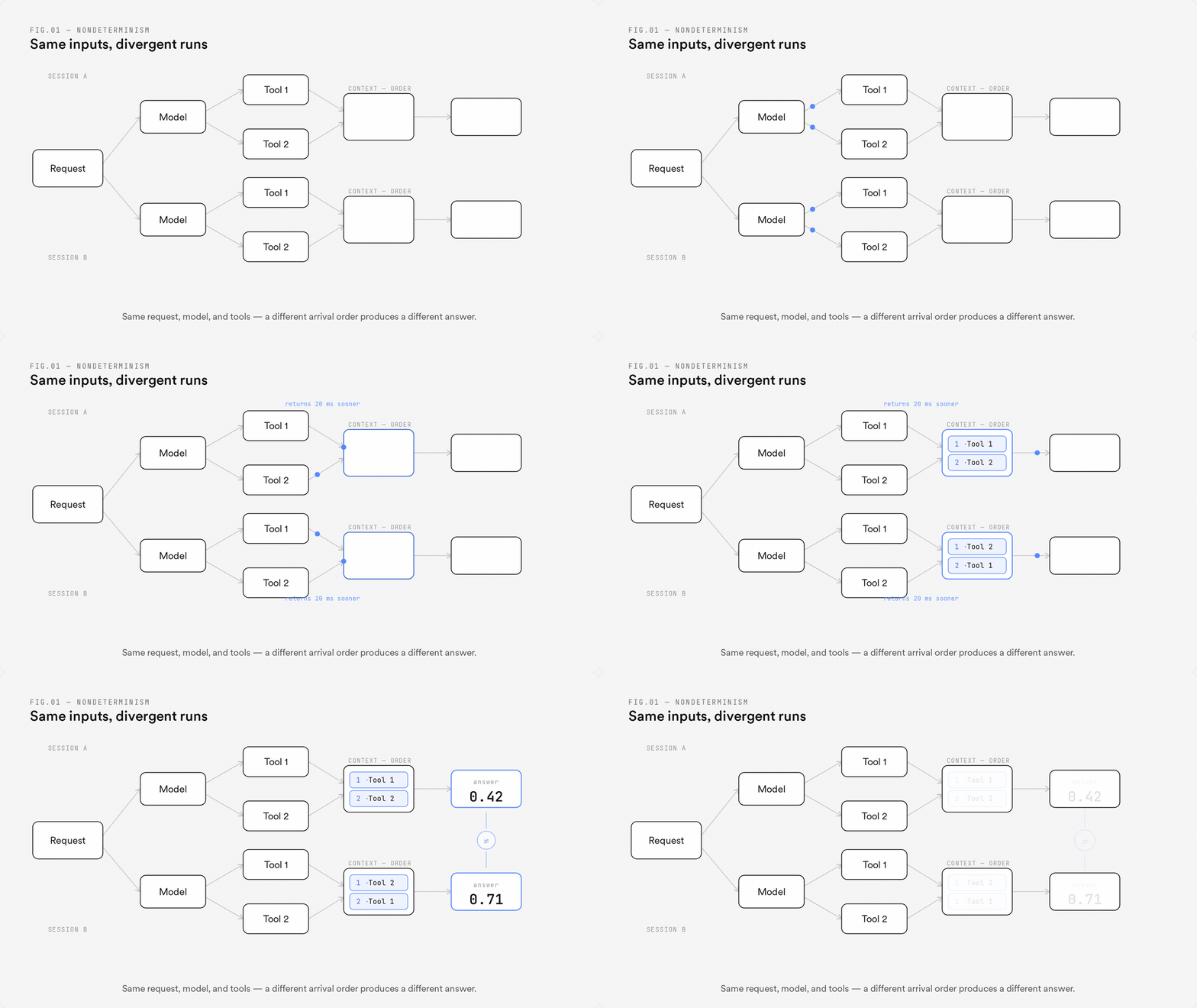
More often than not, the failure is not particularly dramatic. Two sessions receive the same request, use the same model, and appear to call the same tools. One completes. The other takes a slightly different path, nothing dramatic, retrieves the same records in another order, retries a tool after a timeout and arrives at a completely different answer. Both traces look plausible. Neither explains why they diverged.
This is the point at which an agent platform stops behaving like traditional software and starts behaving like several nearby versions of the same software, selected by timing.
It’s not the model
The ‘traditional’ response to this is to investigate the model. Temperature is reduced, prompts are tightened, perhaps a stronger model is substituted. These changes can improve answer quality, but they do little for execution consistency because the model is rarely the only source of variation.
A production run is shaped by the order in which messages arrive, which tool result returns first, whether a request hits a cache, how a retry is scheduled, which retrieval candidate receives a marginally higher score, and what state was left behind by the previous turn. Even timestamps and generated identifiers can alter later behavior if they enter the context or are used as lookup keys.
None of these variations is large enough to look like a platform fault on its own, but together they destroy reproducibility.
So does that matter? Well, yes. Reproducibility is the boundary between an operational system and a convincing demonstration. A demonstration needs to work, perhaps just to justify a budget. An operational system needs to explain what it did, resume after failure, and produce evidence that a proposed fix addresses the same execution that failed.
In short - a log or a trace is not enough.
Logs are observations emitted by a running process. They are frequently incomplete, asynchronously written, and detached from the state that gave an event its meaning. A tool log may show that a request was submitted twice without revealing whether the second submission reused the first execution, started a duplicate job, or observed different upstream data. A model trace may contain the final prompt while omitting the retrieval ordering, evicted tool output, or cache decision that produced it.
The Missing Layer: Deterministic Execution
The missing component to all this is a deterministic execution layer between the model and the distributed systems around it.
That layer does not necessarily attempt to make language generation mathematically deterministic. What it does do is make the surrounding computation deterministic enough that model variation is visible rather than mixed with orchestration noise.
Strict Event Ordering
The first requirement is strict event ordering.
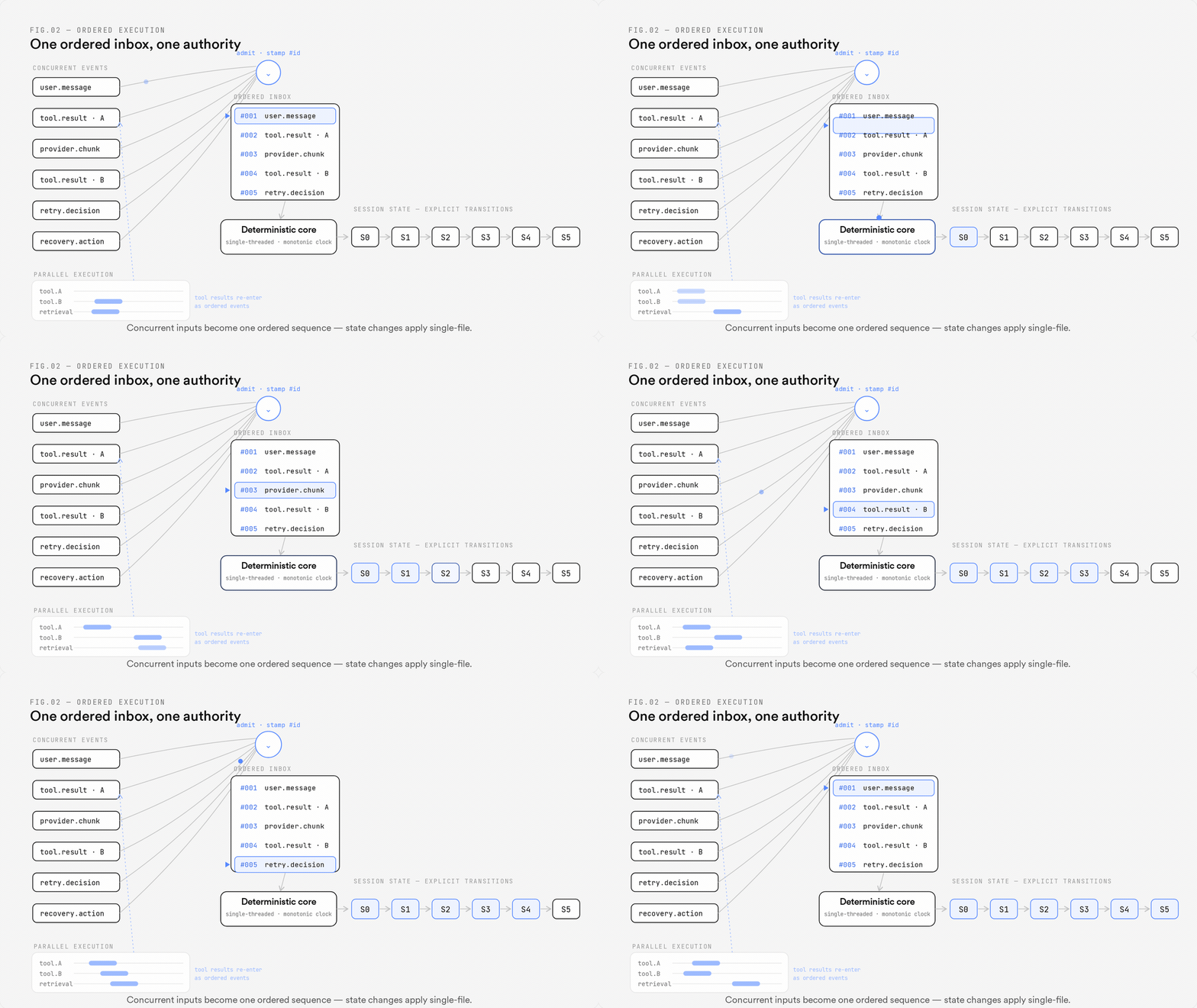
Agent runtimes are naturally exposed to concurrency. User messages arrive while tools are running, and multiple tools may be dispatched in parallel. Provider streams emit incremental output. Recovery policies introduce retries, route changes, and context compaction. If these events mutate session state as they arrive, wall-clock timing will naturally become part of the program.
A hundred real world variations can cause this to happen. A tool that completes 20 milliseconds earlier may enter context first. A retry callback may race with a cancellation. A session update may be accepted between two tool results. The resulting trace will still look reasonable, but the state transition order is no longer stable.
A more reliable runtime treats inbound activity as an ordered event stream. Events may be produced concurrently, but state changes are applied synchronously by one authority. The core consumes one ordered inbox and advances the session through explicit transitions. Model requests, tool completions, retry decisions, recovery actions, and external inputs all acquire a defined position in that sequence.
This design can sound conservative to teams accustomed to extracting parallelism from every service, but crucially, the restriction applies to state mutation, not to all work. Tool calls can still execute concurrently. Retrieval can still fan out. Model traffic can still be streamed. What cannot remain ambiguous is the order in which their results become part of the agent’s state.
A single-threaded deterministic core is often the simplest implementation. It removes an entire class of locking, race, and causal-ordering problems. More elaborate state machines can provide the same property, but they still need a single agreed sequence for state-changing events and a replayable transition function.
Timestamps and identifiers belong inside this boundary as well. If they are generated from ambient wall time or random UUIDs during replay, the replay is already different. A deterministic clock and reproducible identifier generation allow restored execution to recreate the same internal references and event metadata.
Materialized Execution Snapshots
This ordered core becomes the foundation for the next requirement: materialized execution snapshots.
Agent sessions are commonly persisted as conversation transcripts. That captures what the user and model said, but not the execution environment in which the conversation occurred. The transcript may refer to files that have since changed, tool results that were truncated, retrieval outputs that were never stored, or subagent state that existed only in memory.
A production checkpoint needs to include the state the agent could actually act upon.
That means sealing the core session state together with the execution trajectory and the session’s working environment. If the agent can create files, transform data, spill large tool outputs to storage, or continue a child agent later, those artefacts are part of the session. Persisting the messages without them is comparable to storing a database transaction log while discarding the database pages.
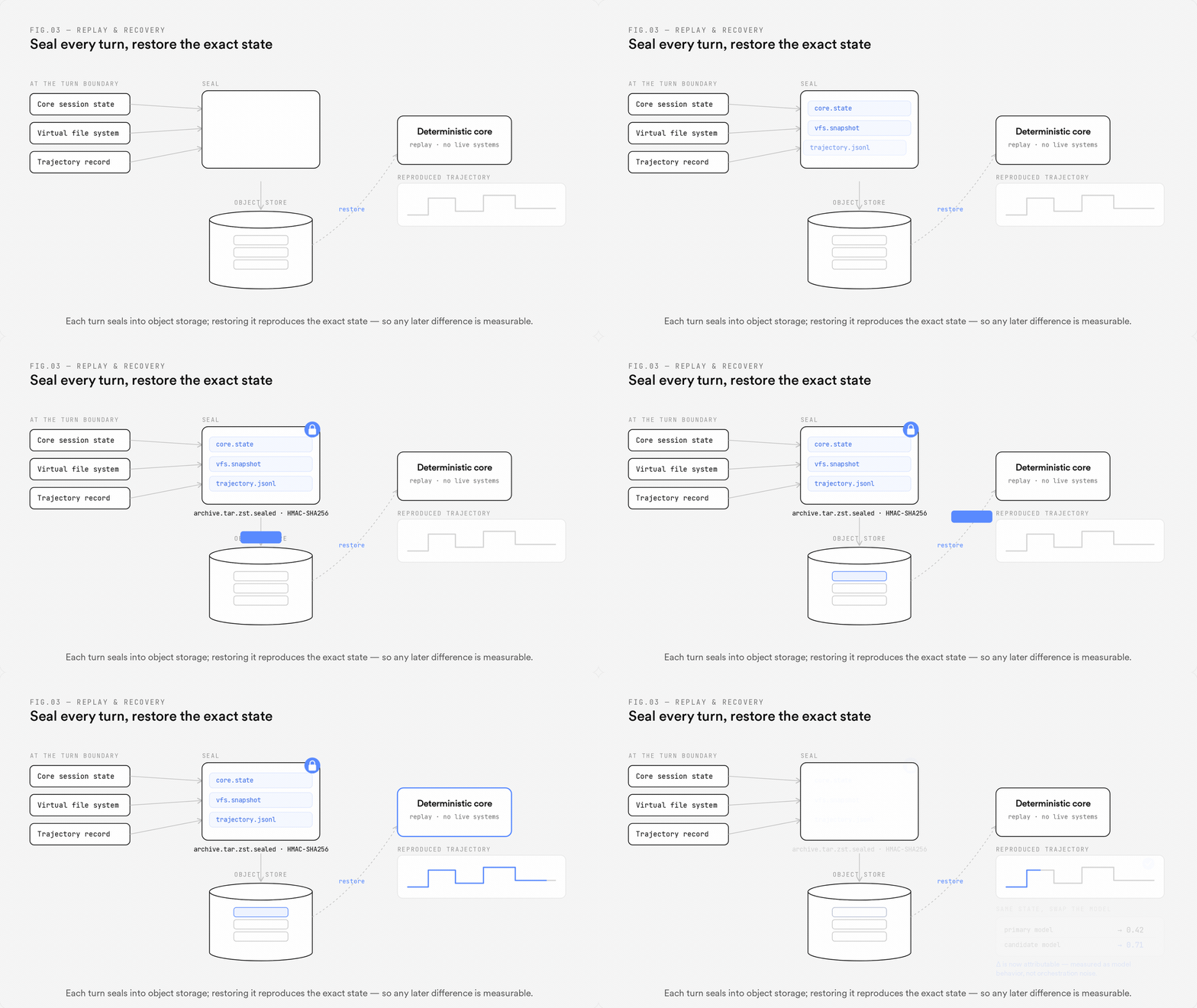
A practical checkpoint can be taken at the end of each turn, when the runtime has reached a durable boundary. The snapshot should contain the model-neutral conversation representation, active policies, tool and recovery state, session labels, durable child conversations, the virtual file system, and a complete trajectory of decisions and external results.
The archive can then be sealed for integrity and written to object storage as one recoverable unit. A compatible runtime should be able to load it and continue from the last committed turn without reconstructing the session from scattered service logs. Before resumption, the target runtime should verify that the required tools, model capabilities, and configuration contract are still available. Why? Because silent restoration into a materially different environment is another form of nondeterminism.
Once snapshots exist, context construction must be derived from them rather than rebuilt opportunistically from live systems, and this is where many otherwise careful platforms lose determinism. A replay loads the same transcript, then reruns retrieval against a changed index. A tool catalogue is searched again and returns a slightly different ranking. Context compaction chooses a different boundary because token estimates changed. An old tool result is re-fetched from a system whose data has moved on.
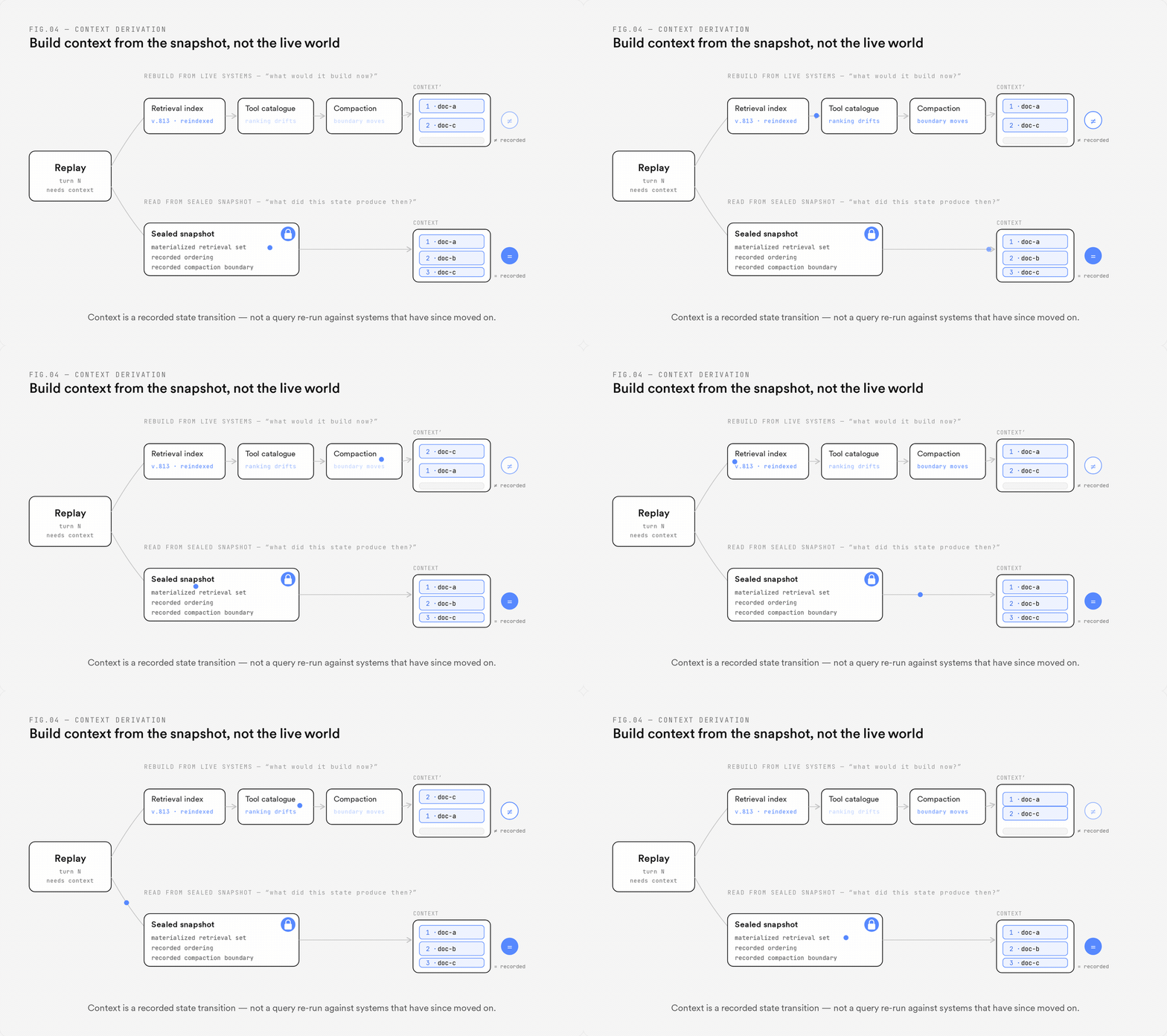
Instead of a replay event asking “What context would the system build now?”, a better question is “What context did this state produce then?”
Context policy can still be dynamic of course. Large results may be moved from the prompt into a session file system. Older turns might be compacted. Tool responses may be re-encoded into a more token-efficient representation. The important property is that these actions are explicit state transitions recorded in the trajectory, and that these transitions are accurately reflected in the snapshot.
The same discipline applies to retrieval. Search systems routinely produce ordering variance because of index updates, floating-point scoring, replica differences, or ties resolved by execution timing. A production agent should either materialize the selected retrieval set as an event or query against a versioned, time-bounded view that can answer as the data existed at the time of the decision.
Without all of this, “replay” means submitting a similar request to a different world.
Tools as State-Bound Events
Tool execution is the most consequential boundary because tools create side effects.
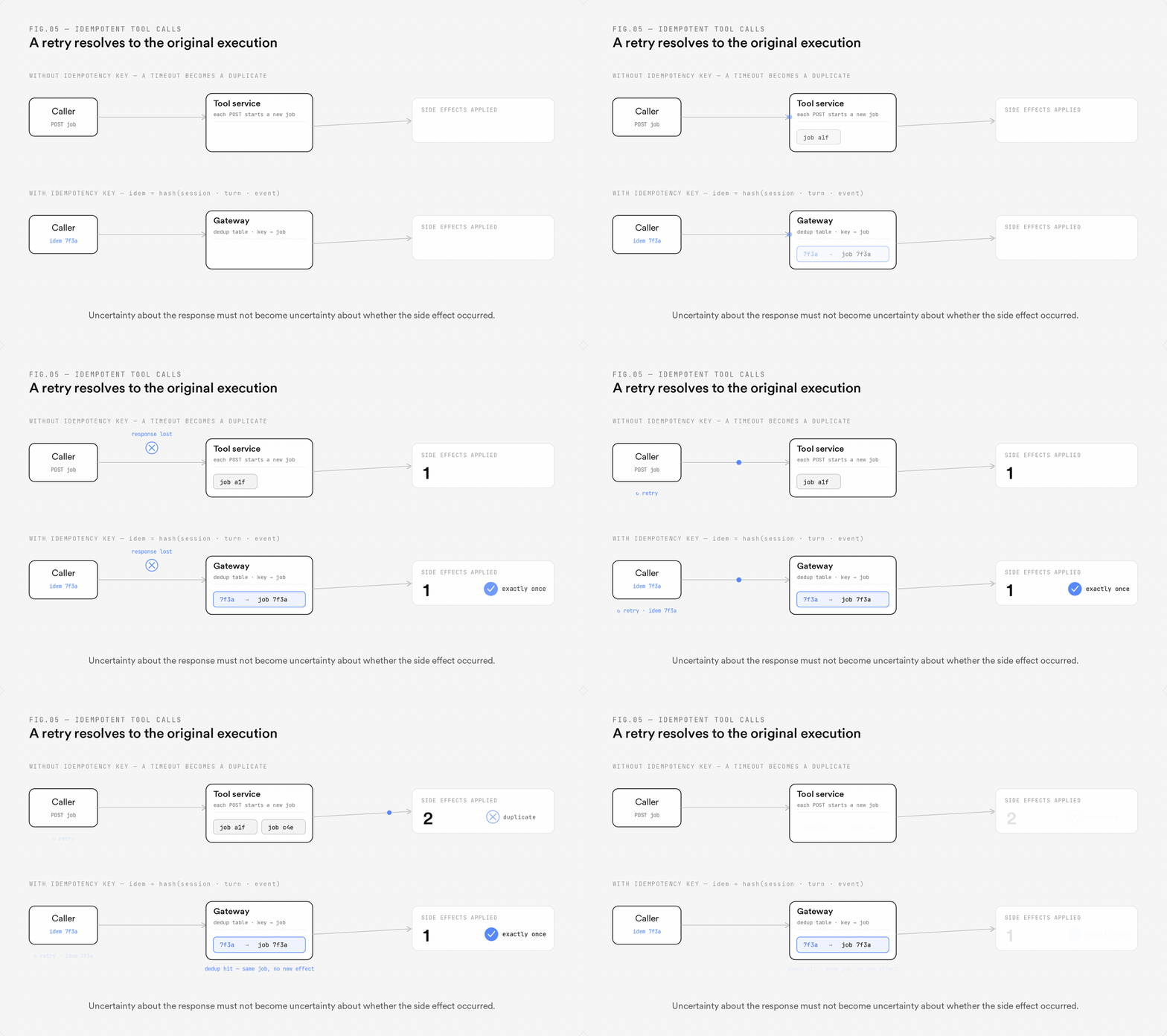
Many orchestration frameworks treat a tool call as an ordinary function invocation. The runtime sends arguments, waits, and inserts the result into the transcript. This abstraction conceals the distributed transaction underneath. The request may be retried by the client, the service mesh, the gateway, or the tool provider. A timeout may mean that the operation failed, or that it succeeded and the response was lost.
A deterministic runtime must therefore treat a tool invocation as a state-bound event with a stable identity. The call must carry an idempotency key derived from the session, turn, and tool event. A retry must resolve to the original execution wherever the tool contract permits it. It must not create a new side effect merely because transport delivery was uncertain.
The gateway can remain asynchronous internally while presenting a synchronous result to the agent. It may submit a job, poll its status, and return only when the job succeeds, fails, or times out. The agent does not need to reason about the gateway’s scheduling. The runtime does need to preserve the job identity, dispatch decision, arguments, result, and retry relationship.
The rule is simple even when the implementation is not: uncertainty about the response must not become uncertainty about whether the side effect occurred.
Mutable storage needs the same treatment. Agent file writes should be versioned and protected by optimistic concurrency. A caller that edits a file must identify the version it observed. If the head has changed, the write should fail and force a re-read rather than silently overwriting a concurrent update. Each successful mutation should create an immutable version linked to its predecessor and attributed to the source session and tool event.
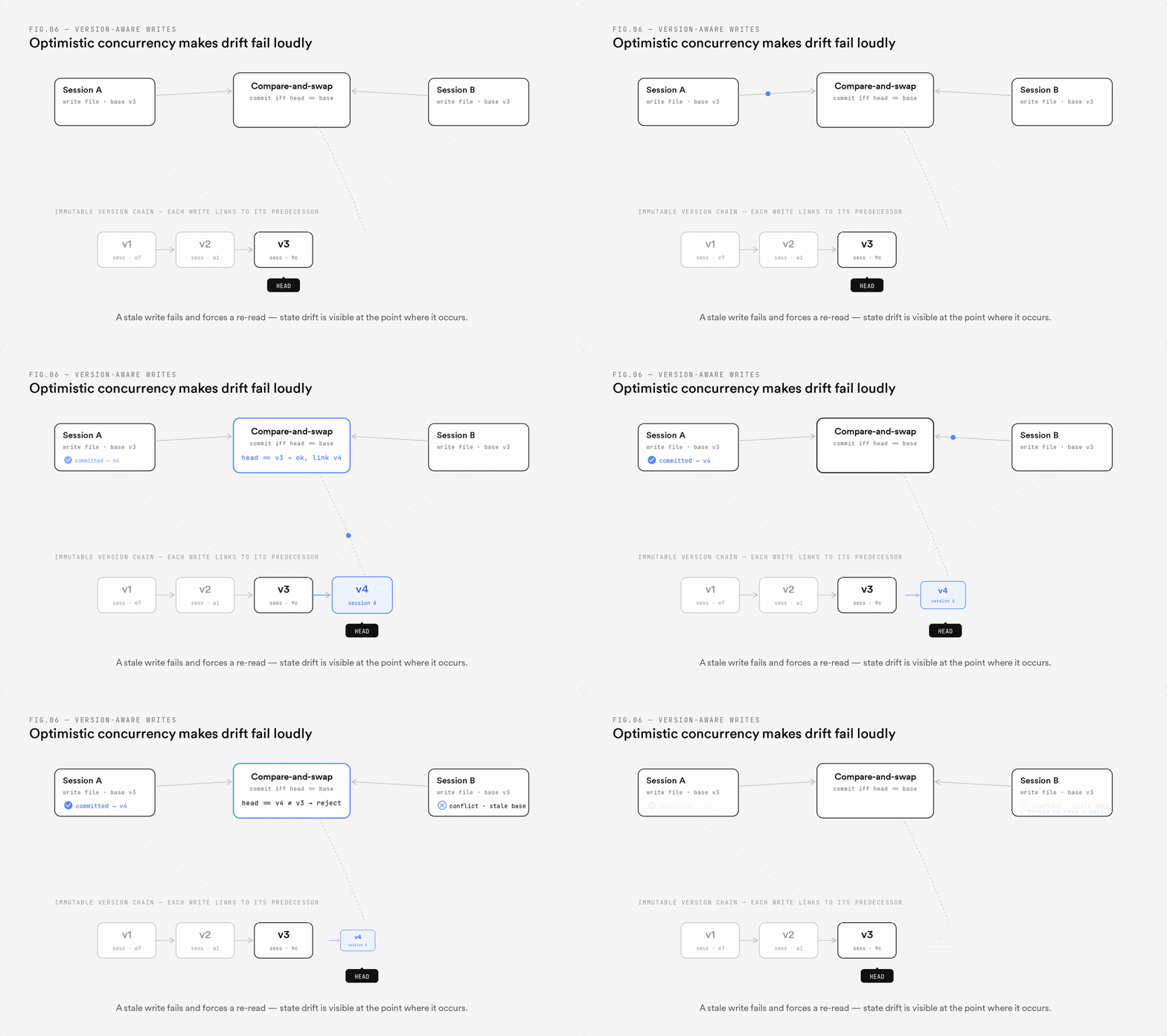
This will produce more than simple auditability. It will ensure state drift is visible at the point where it occurs.
An Incremental Implementation Path
For in-house builds, the implementation path is usually incremental. The ordered event core should come first because every later guarantee depends on it. Existing tools can initially be wrapped as events even if their downstream idempotency remains imperfect. Turn-boundary snapshots can then capture conversation state, event history, and tool outputs. The session file system and other working state can be added once the restore contract is stable. Context policies can subsequently be moved into deterministic transitions, followed by stronger tool deduplication and versioned external state.
Trying to begin with a complete reference architecture tends to create a large program with little early operational value. The useful milestone is narrower: take one failed production session, restore it from a committed boundary, and reproduce the same state transitions without contacting systems that were not contacted in the original run.
The architecture we describe here evolved over a focused period of real world implementations, culminating in the “ContextOne” product. We use an ordered, single-threaded core, deterministic clocks and identifiers, turn-boundary archives containing sealed session and file-system snapshots, durable trajectories, idempotent tool identities, version-aware writes, and recovery policies owned by the core rather than hidden inside transport layers. For the curious, single threaded does not mean slow either - in a 30 minute long agent turn, our own overhead is less than 10 milliseconds.
These choices impose cost. More state is persisted. Tool results must be retained. Event schemas need versioning. Compatibility checks become part of deployment. Engineers must distinguish between parallel execution and ordered state application. Product teams lose some freedom to patch behavior through invisible middleware.
The return is not simply fewer failures. It is control over failures.
When a model produces a different answer from the same preserved state, that difference can be measured as model behavior. When a tool returns different data, the changed external observation is visible as an event. When a retry occurs, the system can show whether it reused or duplicated execution. When a deployment changes prompts, tools, or recovery policy, recorded sessions can be replayed against the candidate configuration and checked for regressions.
That is the operational value of determinism in agent systems. It turns an opaque sequence of plausible actions into a state machine that can be recovered, audited and compared.
Senior engineering leaders do not need agent systems to behave identically forever. They need to know which differences were intentional, which were produced by the model, which came from changing data, and which were introduced by the runtime itself. Without a deterministic layer, those causes remain entangled. Every incident becomes a reconstruction exercise, and every apparent fix is tested on a run that may not be the one that failed.
Production trust begins when the system can preserve its own history closely enough to disagree with it.
 | A guest post by
|